Showing posts with label characters. Show all posts

Saturday, October 22, 2016

Character design in Kalaban

BlogLine

Hello there, fellow readers!

I've talked about monster design before, but I've never gone into the detail of creating a NPC. These are the non-playable characters that roam the game world, and who you interact with.


Colored illustrations of Pena and Cultist henchmen.


The process begins with either me or Tuukka writing a simple description of the character. Who they are, what's their purpose and what they do in the story. Then, our character designer Vesa-Pekka takes the description and draws a sketch art based on the description. If the sketch art is fitting, and matches the soul of the character, we move on to the illustration.

All the colored illustrations in the game are done by me. I take the drawing to Photoshop, and create a new picture based on its design. I don't do a direct line drawings, but I do want the art to closely represent the sketch art.


Sketch art by Vesa-Pekka on the left, and my illustration on the right.


 Actual textures used on the prerendered model.


After the 2D illustration is finished, I take the picture and create the in-game model based on its look. I use the excellent MakeHuman software in the creation of human characters, as modeling them all by hand would take way too much time and effort. After all, our core team consists of four developers, and all the other guys in the team have other day jobs aside from the game development. I'm the only one working on the game full-time, so that brings an extra challenge to the mix.


Prerendered sprites of the model, with correct lighting and shadows.

Close-up of the prerendered model.


All the textures on the models are original paintings, so that they follow the hand-drawn art style. When viewed separately, they are quite simplistic. I've figured, that you don't need a huge amount of detail, when the finished model is going to be a 128 pixel wide sprite on the screen.

When the 3D model has been finished and animated, I render the animations to separate images. Then I take the images to Photoshop, add shadows, shading and color correction to them. After that I export the sequence to the game-ready sprites. Those sprites then become active objects inside the game, which you can interact with. 


Paula's sprite in real-time.

Kaarina encounter and dialogue in-game.


The length of the process varies a lot. The illustrations and textures take about a day to finish, and sometimes I can get a whole character done during one workday. With all the animations, tweaks, etc. it might take two days. If there are some necessary corrections, the process might take up to 2-4 days total. And that's just the visual side. 

Then adding the gameplay element takes a lot more time. That really varies, and is usually a process of weeks or months, and is done in tandem with other development. The writing process behind the NPCs also varies a lot. Some characters were written in a day, others were a result of several months of planning. When you finally see it in the game and interacting with other elements, you can get into the fine tweaking. 
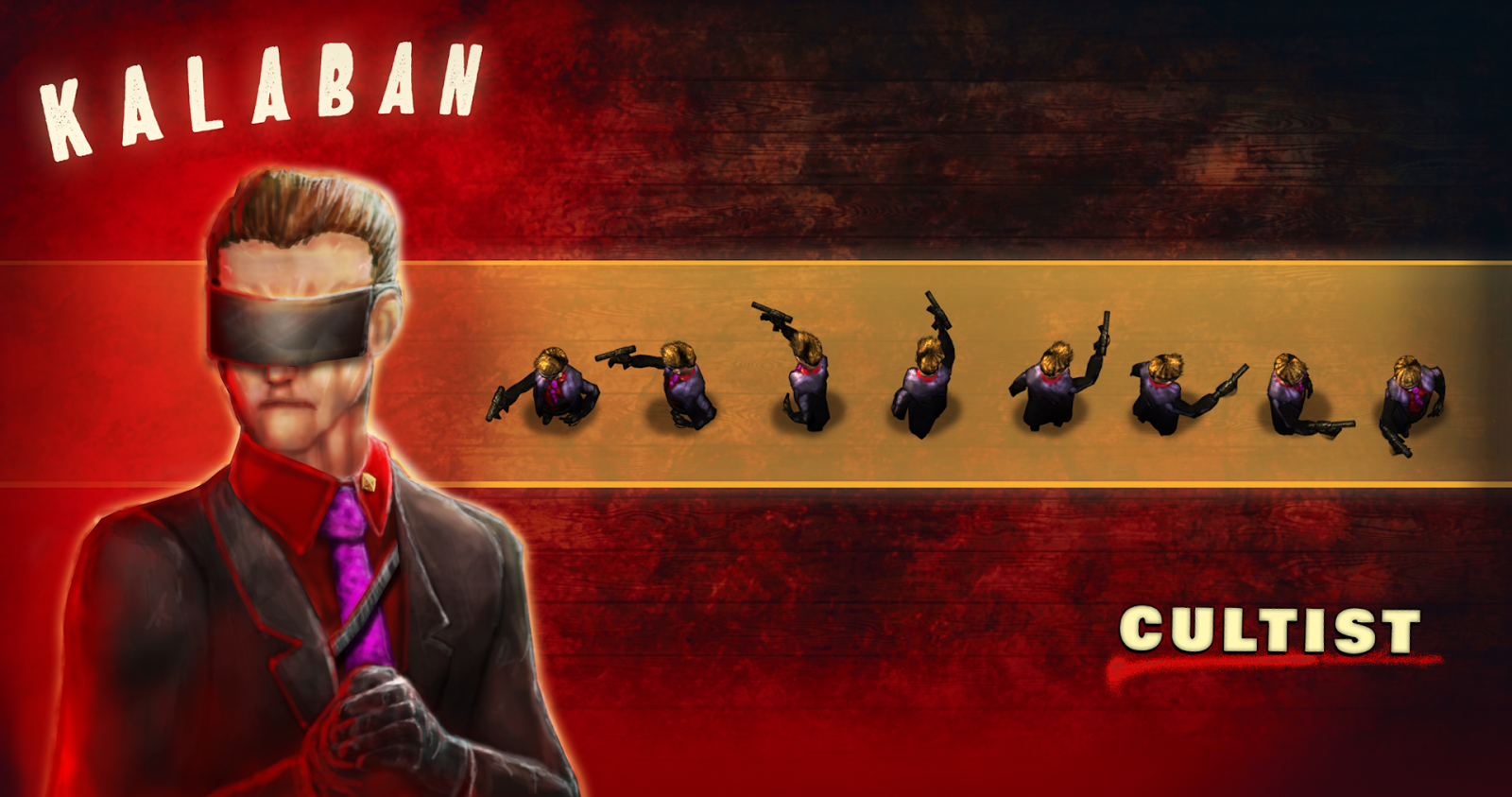

Cultist henchmen sprites. One of the few hand-crafted human models in the game.

NPC encounter at the purification plant.


The more you have elements interacting with each others, the more complex it gets. When you only have a couple of enemies running around with one NPC, things are fairly simple. But when you have a wide cast of characters with their own quests, side objectives and behaviors, it's much harder to keep track of. 

But that's the whole beauty of developing an open-ended game. The fact that you get to change the character's fate is an exciting feature. And once you've tasted that player-driven narrative, you can't go back to simple arcade games. 

Saturday, July 2, 2016

Enemy profile: The Blow-up

BlogLine

Howdy! At the moment we're working on multiple new enemies for the game. One of them is the Blow-up, an insect monster, which explodes when it gets close to the player.

Sketch art by our multi-talented musician / sound guy Eetu Suoranta.


We've had a certain enemy roster in mind from the very start, but we've wanted to take things slow with it and not add all of them at once. This way we've had the time to balance the game, and program the weapons before having a dozen different enemies charging towards you. Blow-up adds a special spice to the battle, and makes you re-evaluate the situation. A well-placed shot at the mutant might take down several others, but getting into close combat with it is often deadly.


I personally have this sort of a love-hate relationship with Crimsonland (2003). It's a fun indie shooter, but that's pretty much all it is. What it does well though is the combat, and especially the minute-to-minute tactics of it.

Designing realtime combat on a larger scale is always a challenge, and there's a lot to take into consideration. Some enemies are fast little guys, who will chew your health away, others are slow walkers which pose no threat alone, and others are ranged enemies, which hurl fireballs and acid projectiles at you.


Bringing all of these elements together creates the feel of the game. That's why designing the Blow-up is not just about adding one enemy character anymore, it's about the whole gameplay in Kalaban. And that's it for this week, I hope you enjoyed this piece! Stay tuned for more updates on the enemies.


Friday, April 22, 2016

Friday diaries #2

BlogLine
Hello!

I did have a plan to keep these Friday diaries weekly, but then stuff happened, and I didn't have time to do one last week. Soooo... Here we are!


Today we'll have a look into the creation of non-playable characters. In addition to the ravenous mutants, you will come accross some normal human beings too. They're survivors, who have fought against the outbreak, or by some random accident been spared by the monsters.


The npc in question today is Mikko the bartender in scene 7. He's a guy who's been through a rough patch, but despite that, or because of it he has survived this long. The character creation in the game always begins with a rough sketch, and then a painted version to give it depth and color. After you have the shape and look figured out, you get into the modeling, and finally of course animation. In the creation of human characters I've decided to use the help of the excellent MakeHuman freeware program.


I'll try to keep you updated frequently from now on. We've currently set an insane milestone to have all the scenes done by the end of summer 2016. We have scenes 1-5 and 7 under construction, and I just began putting the sixth scene together in Photoshop. So, we still have six whole scenes to create from scratch before that...

Anyways, thanks for tuning in and see you soon!

Thursday, March 3, 2016

New and very tasty

BlogLine

Howdy y'all!

It's been busy here at Rayhouse with the Kalaban's development heating into full gear again. We've had some lengthy discussions with our four guy power team, and from our creative director's initiative we've decided to put our focus on the first act of the game. Kalaban was originally meant to span over the course of three acts, with a total playtime of over 5 hours. Now we've decided to put the environments to a better use, and flesh out the scenes more. This way we will not (maybe) work ourselves to death, and will be able to deliver a finished game, maybe during this year even!


Indiedb Verticalslice
So yeah, the original plan was pretty suicidal from the start, but it became even more evident during the development. We've been working on Kalaban for over a year now, and a couple of things have become very clear to us. First of all, gamedev is friggin hard, which should come as no surprise. Secondly, the environments take a load of time to make. The optimal time to make one scene is one month, but for example the Scene 3 took us three months to build. There were some heavy iterations, yes, and the game was still in very early stage back then. Even the plan for Act I includes a total of 13 scenes. We currently have six of them under construction, so there is still A LOT of work to be done.

Bob fighting against a Spitter in scene 7.


Indiedb Morefleshed
Of course this new arrangement won't mean that the game will be an hour-long experience. We're aiming for the core gameplay to be a total of four hours, plus bonus content and side quests. The most interesting thing about Kalaban is the setting and how it affects the art direction. The story is set in an alternate past of Finland, so we're constantly making sure that the elements in the game match that. The gameplay will be more like a detailed and unique adventure game, in the style of DreamWeb (1994), than just a top-down shooter like Alien Shooter (2003) or Crimsonland (2003).

A check-list of things Bob must collect in order to complete his quest.


Indiedb Rewritten
In favor of making the game more engaging, we've re-written the main quest for the game. Originally, the Act I served as an introduction to the story, and told the very first steps of the outbreak. Now, the objective is to find a car and escape to the city, and hopefully reach safety there. Of course we still have a general plan for the future events of what happens when Bob reaches the city. If this game does really well, and there is a serious demand for it, we will continue with part 2 and part 3 of the story.

Bob has reached the momentary safety of the local pub and its beer storage.


Indiedb IntroducingNPC
The original plan for the whole game was to have maybe one or two brief NPC encounters, but to keep the game otherwise a desperate one man battle against the mutant horde. This was largely inspired by the way System Shock (1994) and its successors handled the story. Now, the locations will feature a number of other survivors, fighting for their life. One of them is Keijo, your former boss and owner of a sawmill. He has seen better days, but is still sane and has been able to fight off the invasion. Some of the NPCs you will be able to save, and maybe even take with you to the city.


That's it for today, thanks a bunch for tuning in! To stay updated on the development progress, either follow us on IndieDB, or keep reading our blog and add it to your bookmarks. See ya!

-

Saturday, February 6, 2016

Enemy profile: The Bruiser

BlogLine

Hello and welcome back!

This week we'll take a look at the first foe which you'll encounter in Kalaban. It's a hybrid of a man and a canine creature. The 'Bruiser' has no ranged attack. It tries to run you down and starts tearing through your flesh if it does.


As you might've heard, the development of Kalaban officially began in January 2015. Before that we tried to create a sidescroller prototype with simplistic action-adventure elements. But that version seriously lacked meaningful and fun gameplay. So, we decided to take the perspective to this topdown/isometric view, where you can see the action from above, and the enemies can creep on you from all the different angles, instead of just two.


 'Bruiser' has gone through many iterations during the development, since it is the first enemy you see in the game. This current version is its fifth iteration. I've experimented with prerendered graphics during its development, and tried to emulate the hand-drawn style of Bob with various results. The current look of the monster is finally aligned with the overall art direction in the game.


When you're creating character graphics and animation, you have to be very conscious of what kind of look you want to achieve. Is your character wobbly? Does it have a limp? Or does it move with a robotic precision? Does it look around and is it aware of its environment? Does the character posses wisdom or intelligence?


The Bruiser is a blunt and mindless mutant, which stumbles around, but slashes its foes with terrifying strength. Its appearance might fool you to think it's almost harmless.

That's all for now, thanks for reading!

Monday, January 18, 2016

Enemy profile: The Spitter

BlogLine

Howdy folks! It's been a while, so we figured we should post a new update. Let me present a new monster to you - The Spitter!


Spitter sketch2

Designing a character always begins with a sketch; an illustration or just a rough scribble. This particular monster is supposed to be a half-snake and half-human. It spits corrosive acid, hence the name. Our character designer, Vesa-Pekka did the rough sketch, and I made the painted version above. The illustration gives you a basic idea of the character; its poses and the general colours.

3d Showcase
The snake which inspired this monster is an adder, which can actually be found from the Finnish nature, and it's one of the only venomous species we have in here. Although Kalaban is set in a fantastical alternate universe, it should be grounded in reality somehow. I like to compare the game's fictional lore to Watchmen, which clearly mirrors the political atmosphere of the era it depicts, but also takes many liberties, like adding sci-fi and comic book elements. Our game deals with a simpler story of course; mutant outbreak in nineties Finland.

SpitterShowcase2

Unlike the animations of our main hero, Bob, the enemies will be done in 3D, and then prerendered into 2D sprites. It would simply just be too laborious to animate all the in-game characters by hand. That's why I built this hi-poly model of the character. I posed the model for the animations and then shot it from different angles. I tried my best to simulate the painted, hand-drawn look.

SpitterShowcase3
Thanks for tuning in! We've had a long break from Kalaban partially because we've been working on Neurotron, our pocket RPG for Android devices. And also because we've done a huge rehaul to the game overall. All the previous code was essentially scrapped. Now that Neurotron is moving along nicely, we can also get Kalaban back on track.